Data MarketplaceThe Output of Validated DecisionsThe Data Marketplace is where validated, decision-backed datasets become reusable assets. When your team makes a validated decision in the Workstation, you have produced a structured, audited, defensible data asset — one that other teams or external parties can purchase and trust because the evidence chain is visible.A Case StudyImagine a pricing team running a B2B cohort analysis. They define the question in the ASK phase, attach sales data and market research as sources, run validation checks in the DECIDE phase, and commit their decision.The resulting dataset — complete with its constraints, validation checks, and Decision Record — is now a verified data asset available in the marketplace. As a data producer, the team chooses how to package it: by analysis period ("Q3 2025 pricing analysis"), by segment ("Enterprise cohort data"), or by granularity ("Individual transaction records with aggregations").Now let's imagine three data consumers who can leverage this validated dataset:
A product team in another division seeking benchmark data for their own pricing strategy, with full confidence in the methodology because the Decision Record is attached.
A consulting partner preparing a market analysis who needs auditable, third-party verified data rather than scraped estimates.
A compliance auditor reviewing the company's decision trail who can verify the data lineage back to the original sources.
They can all license the dataset independently. The Data Marketplace transforms isolated analytical work into reusable organizational knowledge — with the trust layer built in.In the example above we clearly see the three key attributes of enterprise data collaboration:
Data Producer — teams that generate validated datasets through the decision workflow
Data Consumer — teams or external parties that license verified data for their own decisions
Trust Layer — Decision Records that provide provenance, methodology, and auditability
Connected to Your Decision WorkflowThe Data Marketplace is not a separate product — it is the natural output of the decision workflow you've already built in the Workstation. When you commit a decision, the structured data, sources, and validation checks become a potential marketplace listing.This integration means:
No reformatting or re-engineering required to share data
Automatic provenance through attached Decision Records
Granular access controls based on cryptographic identity
Direct connection between data consumers and the teams that produced it
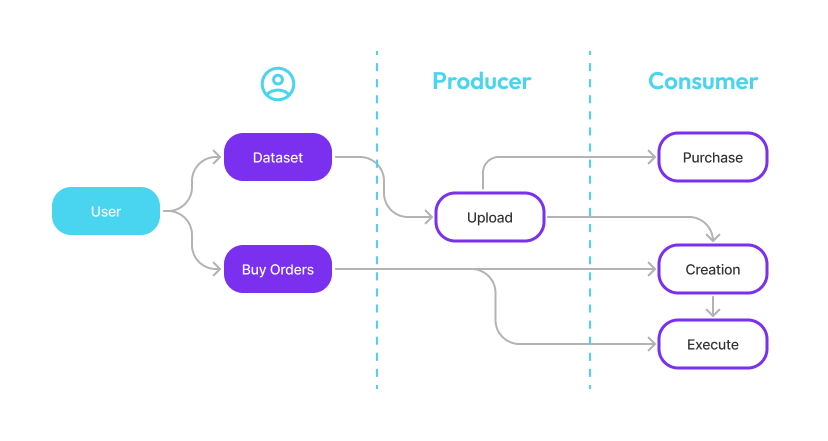
How does the Data Marketplace work?The marketplace includes all the functions and features necessary to support the buying and selling of data. This includes upload and management features for sellers, search and discovery features for buyers, and secure payment and delivery mechanisms to ensure a successful transaction.
The two main attributes that constitute the workflows of the marketplace are:
The dataset is the consolidated data that a producer will deliver to a consumer.
The buy order is the tender a consumer creates to attracts potential datasets.
For a deeper dive into the works of the data marketplace, have a look at our How do I use Learning Nodes? section.PrivacySharing data and privacy are two ends of the same stick! This is why at Learning Nodes we've upped the ante by forcing users to use a cryptographic identity to login to our ecosystem - more on that in the Connect Account section.You'll also have the flexibility to choose the level of sharing you're comfortable with:We also take pride in saying we are using the latest benchmarks applied to data privacy. Guaranteeing a fully encrypted connection, as well as an encryption in our DB which can only be accessed through an authenticated session (MFA)."But I want more!"Good, you will also have the flexibility to choose the level of sharing you're comfortable with:
Public: Easily accessible through the "Browse" section.
Unlisted: Only visible through a unique link initially shared by the uploader.
Private: Accessible only to those cryptographic identities on a permission list defined by the uploader.
Note: It is important to emphasize with extreme clarity that we will respect the transactional value of private property but will not make any effort to use security features for secrecy.
 For a deeper dive into the works of the data marketplace, have a look at our How do I use Learning Nodes? section.PrivacySharing data and privacy are two ends of the same stick! This is why at Learning Nodes we've upped the ante by forcing users to use a cryptographic identity to login to our ecosystem - more on that in the Connect Account section.You'll also have the flexibility to choose the level of sharing you're comfortable with:We also take pride in saying we are using the latest benchmarks applied to data privacy. Guaranteeing a fully encrypted connection, as well as an encryption in our DB which can only be accessed through an authenticated session (MFA)."But I want more!"Good, you will also have the flexibility to choose the level of sharing you're comfortable with: