Data MarketplaceA Case StudyLet's say an influencer dedicates herself to making recipes and posting them on Instagram, she has accumulated 1 million followers and wishes to increase her revenue streams without needing to invest much additional time (working on the channel is tough!)She decides to download her Instagram analytics, these include the recipe title, wording she used, ingredients, and hash tags, as well as likes and comments and their likes distributed by timestamp and geolocation.This report she downloaded from Instagram is now a dataset and can be uploaded to the data marketplace to be sold. As a data producer, she'll have to choose how she wants to sell the dataset, will she sell information by the day? ("I want to buy 10 days of traffic data"). By the post ("I want to buy the total traffic generated by 10 posts"). This choice refers to the granularity of the dataset - the basic unit of measure for quoting the price of the dataset.For example, if she chooses to sell each day of information for 10 dollars and she has two years worth of information, the dataset would be worth 365 days x 2 years x $10 dollars = $ 7.300 dollars.Now let's imagine three data consumers:
A head of product for a food business who wants to launch a new feature on the product which will take UX findings and mix them with current food preferences in the market.
A marketing specialist who is about to launch a new campaign for a food related industry and is looking to understand what time and location would have the most impact.
A food related startup looking to raise funds to become a series A who want to support their business case with market data.
They can all purchase the dataset, independently, and furthermore, there may be multiple of each of these generic individuals that want to purchase the dataset. Multiply the price of the dataset times the amount of buyers, and you've got a pretty decent additional revenue stream!In the example above we clearly see the three key attributes of data collaboration:
Data Producer
Data Consumer
Marketplace interaction
We need more Data CollaborationAt Learning Nodes, we want the data marketplace to enable data collaboration, plain and simple. For this, we've performed a (rather long and tedious) UX exercise*, applying years of industry experience in procurement, data governance, and data engineering to provide a centralized platform where individuals and organizations can buy and sell data in a secure, efficient, and transparent manner.What can you expect from the data marketplace? A seamless data collaboration experience for both buyers and sellers. This includes streamlining the uploading process for data, providing intuitive features for setting prices and managing sales, and making it easy for buyers to find the data they need.*The exercise is really a continuous improvement framework. Meaning that we'll be constantly listening and applying the necessary mods so Learning Nodes can scale and evolve over time to meet your changing needs.How does the Data Marketplace work?The marketplace includes all the functions and features necessary to support the buying and selling of data. This includes upload and management features for sellers, search and discovery features for buyers, and secure payment and delivery mechanisms to ensure a successful transaction.
The two main attributes that constitute the workflows of the marketplace are:
The dataset is the consolidated data that a producer will deliver to a consumer.
The buy order is the tender a consumer creates to attracts potential datasets.
For a deeper dive into the works of the data marketplace, have a look at our How do I use Learning Nodes? section.PrivacySharing data and privacy are two ends of the same stick! This is why at Learning Nodes we've upped the ante by forcing users to use a cryptographic identity to login to our ecosystem - more on that in the Connect Account section.You'll also have the flexibility to choose the level of sharing you're comfortable with:We also take pride in saying we are using the latest benchmarks applied to data privacy. Guaranteeing a fully encrypted connection, as well as an encryption in our DB which can only be accessed through an authenticated session (MFA)."But I want more!"Good, you will also have the flexibility to choose the level of sharing you're comfortable with:
Public: Easily accessible through the "Browse" section.
Unlisted: Only visible through a unique link initially shared by the uploader.
Private: Accessible only to those cryptographic identities on a permission list defined by the uploader.
Note: It is important to emphasize with extreme clarity that we will respect the transactional value of private property but will not make any effort to use security features for secrecy.
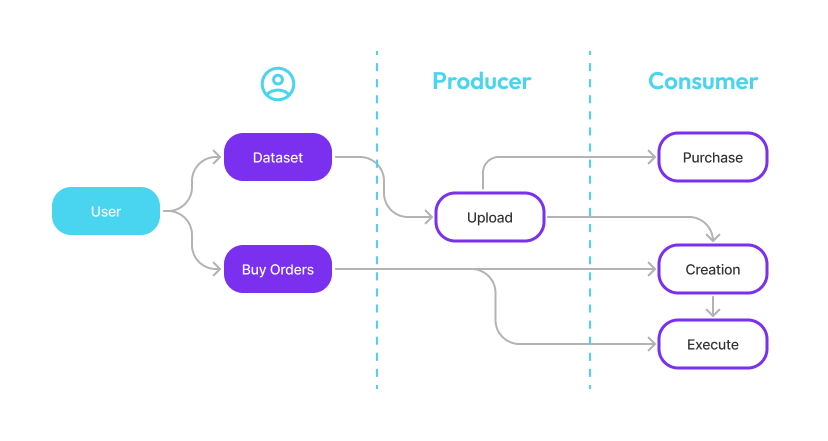 For a deeper dive into the works of the data marketplace, have a look at our How do I use Learning Nodes? section.PrivacySharing data and privacy are two ends of the same stick! This is why at Learning Nodes we've upped the ante by forcing users to use a cryptographic identity to login to our ecosystem - more on that in the Connect Account section.You'll also have the flexibility to choose the level of sharing you're comfortable with:We also take pride in saying we are using the latest benchmarks applied to data privacy. Guaranteeing a fully encrypted connection, as well as an encryption in our DB which can only be accessed through an authenticated session (MFA)."But I want more!"Good, you will also have the flexibility to choose the level of sharing you're comfortable with: